Drinking Glasses for Everyday Water, Juice and Long Drinks
Most people buy drinking glasses twice. Once when they set up a kitchen, and again two or three years later when the set has quietly shrunk to four mismatched survivors. The second purchase is almost always the better one, because by then you know exactly what went wrong with the first.
What usually went wrong is one of three things: the capacity was wrong for how you actually drink, the rim was too thin to survive daily washing, or the set was bought in pieces over time so nothing matched. None of those are expensive mistakes on their own. Together they are why a glass cabinet looks tired after eighteen months.
This page is built to stop that happening a third time. It covers what capacity suits which drink, which glass material handles heat and which does not, how many glasses a household or a restaurant actually needs, and where each glass in the SILICOX range fits. Read the material and capacity sections, and the rest of the decision usually makes itself.
Partitioned Packing
Each glass cushioned separately, not loose in a carton
🛡️
Food-Grade, Lead-Free
BPA-free and cadmium-free across the range
🧾
Retail & Wholesale
Sets of 2, 6 and 12, plus bulk with GST invoicing
🏷️
Private Labelling
Own-branding available on eligible bulk orders
Drinking Glass 101
What Exactly Is a Drinking Glass?
A drinking glass is a stemless, handle-free glass vessel made for cold and room-temperature beverages – water, fresh juice, lassi, chaas, nimbu pani, iced tea, soft drinks and mixed drinks. The technical name is a tumbler, and that single word is what separates it from the two things people confuse it with: stemware, which has a stem and a foot and is built for wine, and mugs, which have a handle and are built for heat.
The distinction matters when you are buying because all three fail differently. A wine glass fails at the stem. A mug fails at the handle join. A tumbler fails at the rim – almost always at the rim – because the rim is the thinnest part of the glass and it absorbs every knock in the sink, in the dishwasher rack and in the cabinet. Rim thickness tells you more about how long a set will last than the brand printed on the box.
A good everyday drinking glass does three unglamorous things well. It sits flat and does not rock when you set it down hard. It feels balanced in the hand when full, not top-heavy. And it survives being washed twice a day for years without the rim going rough. Everything else – shape, tint, pattern – is preference. Those three are the specification.
What Is a Drinking Glass Called?
A drinking glass is called a tumbler. The wider category names are drinkware and glassware. Within that, glasses are named by capacity and shape: a water glass, a juice glass, a highball, a Collins glass or a rocks glass. In everyday Indian usage it is simply “a glass”, and trade catalogues will list the same product as a water tumbler.
What Is a Synonym for a Drinking Glass?
Tumbler is the closest single-word synonym. Glass, beaker, water glass, drinking vessel and highball are all used depending on context. Stemware and mug are related terms but not synonyms, because a drinking glass has neither a stem nor a handle – that is the whole definition.
Material Guide
The Four Types of Glass Used in Drinkware
Glass is not one material. These four behave completely differently under heat, impact and daily washing.
1. Soda-Lime Glass
Silica, soda ash and lime. Roughly nine out of ten glass products made worldwide, including almost every tumbler sold in India. Clear, food-safe, light and cheap to replace. It tolerates a sudden temperature swing of only about 30-40 °C, so it is a cold-drink glass and nothing else. For everyday water and juice, it is the correct choice.
2. Borosilicate Glass
Soda-lime with boron trioxide added, which sharply lowers thermal expansion. It handles a temperature swing well over 100 °C, which is why teapots, travel mugs and lab glassware are made from it. For a cold-drink tumbler it is more expensive than it needs to be – buy it only when the same vessel has to take hot tea or coffee.
3. Tempered (Toughened) Glass
Soda-lime that has been reheated and then rapidly cooled, putting the surface under compression. The result is markedly more impact-resistant, and when it does fail it breaks into blunt granules rather than sharp shards. The right pick for canteens, schools and high-volume cafes where breakage, not wear, is the real cost. Still not a hot-drink glass.
4. Lead Crystal
Glass with lead oxide added for weight, ring and light refraction; lead-free versions substitute zinc, barium or potassium. It is genuinely the most beautiful of the four and the worst for daily use – most fragile in handling, and unsuitable for storing acidic drinks, since lead can migrate into liquid over extended contact. Keep it for display and occasional barware.
So Which Glass Is Good for Drinking?
For a glass that lives on the shelf and gets used every day, soda-lime wins on every practical measure. It is clear, food-safe, light enough that a child can hold it full, and when one breaks the replacement costs very little. That last point matters more than people expect, because glassware is a consumable and a set you are afraid to use is a set you will stop using.
Move to borosilicate only when the same vessel has to take a hot pour, at which point you are really buying a glass mug rather than a tumbler. Move to tempered when breakage volume is the problem rather than looks. Skip lead crystal entirely for anything you drink from daily – for a drink poured and finished within the hour the exposure is negligible, but there is no reason to accept the trade-off on everyday glassware at all.
A Note on the Word “Crystal”
“Crystal-clear” and “crystal” are two different claims. The first describes clarity in ordinary glass; the second describes composition. If a listing does not state lead content anywhere, treat it as ordinary glass – which, for a drinking glass, is the better outcome anyway.
And If You Meant Construction Glass
The question “what are the four types of glass” also has a building-industry answer: annealed, tempered, laminated and coated. Different classification, different industry. If you are buying tumblers, the drinkware set above is the one that applies.
Sizing
Drinking Glass Capacity Guide: How Many ml Do You Need?
Capacity is the single decision that determines whether a glass gets used daily or pushed to the back of the cabinet.
150-180 ml – Small Juice and Kids’ Glasses
Suits concentrated juice, children’s portions and welcome drinks. The narrower body is genuinely easier for small hands to hold, which is why it belongs in a household with young children. As a water glass it is too small – you will spend the meal refilling it.
200-230 ml – The Juice Glass
The right size for fresh juice, lassi, chaas, milkshakes and breakfast service. It is also what most cafes use for a short pour, because a smaller glass makes a modest serving look generous rather than mean. Tight if the drink is going over ice.
250-300 ml – The Standard Water Glass
The all-purpose capacity and the most common size on Indian dining tables and in restaurants. It holds a full serving of water without a refill, takes ice and a mixer without overflowing, and is still comfortable to hold and wash. If you are buying only one size, buy this one.
300-350 ml – Highball
Built for long drinks over ice: iced tea, cold coffee, sodas, mocktails and spirit-plus-mixer drinks. The extra height is doing real work, not styling – more on that in the range section below. The one trade-off is that taller glasses tip more easily on a crowded table.
400 ml and Above – Coolers and Long Tumblers
For smoothies, layered coolers and outdoor serving. Heavy when full, and awkward for children and older hands, so it works better as an occasional glass than as the household default.
The short version: if you want one set that covers almost everything, buy 300 ml. Add a 210-220 ml juice glass alongside it and those two capacities handle roughly ninety per cent of what an Indian household pours in a week.
Explore the Range
The SILICOX Drinking Glass Range
Four glasses, each solving a different problem. Here is which one belongs in your cabinet.
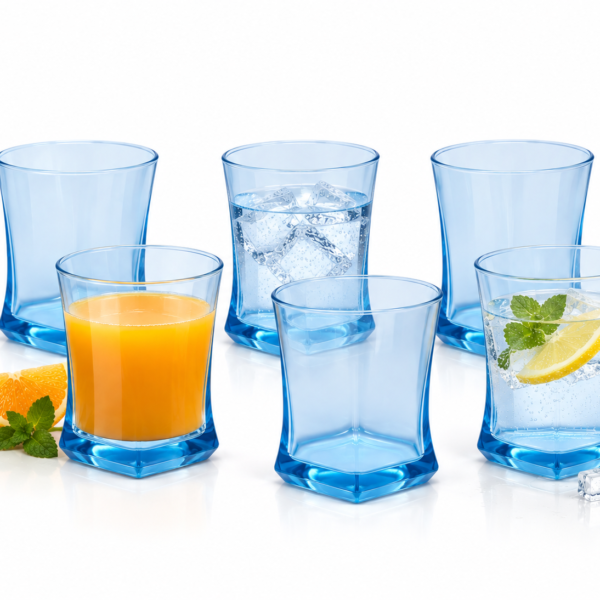
This is the glass most Indian homes and restaurants reach for first. At 300 ml it holds a comfortable serving without constant refills, and a slightly heavier base than decorative glassware means it survives hand-washing or a dishwasher cycle day after day. Our Highball and Blue Glass sets both sit at this capacity, one clear and one tinted through the body.
Juice Glasses
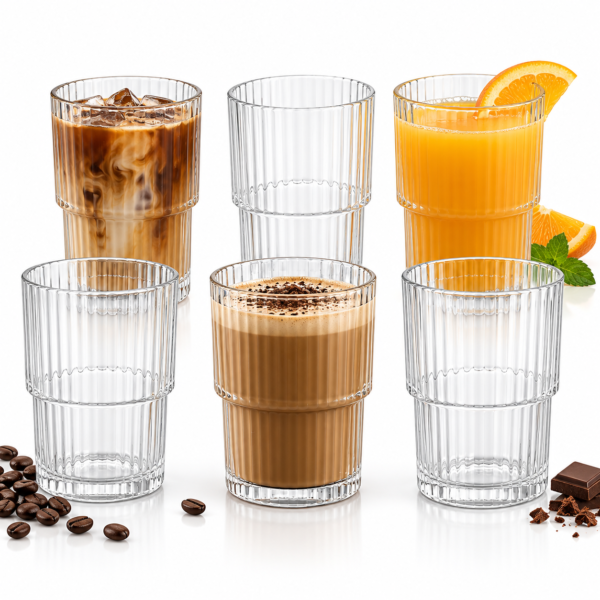
Slimmer and shorter than a water glass, typically 200-230 ml, and suited to fresh juice, lassi, chaas and milkshakes. Clear, undecorated glass is preferred because it lets the colour of the drink show, which is exactly why juice glasses dominate breakfast service and cafe counters. The Italian Juice Glass at 220 ml is the straight-sided version of this shape; the Red Flowers Pattern set at 210 ml is the printed one.
Highball Glasses, and Why Tall Shapes Exist
There is physics behind the height, not just styling. In a narrow glass, ice cubes stack vertically and each cube shields the next, so less ice surface touches the liquid and the melt rate drops. The narrower opening also exposes less liquid to air, which is where carbonation escapes. A soda in a tall highball holds its fizz noticeably longer than the same soda in a wide tumbler – the same reasoning behind serving sparkling wine in a flute.
Highball vs Collins vs Rocks
These three get used interchangeably in Indian retail listings and they are not the same glass. A highball is tall and straight at roughly 240-350 ml, for long drinks over ice. A Collins is slightly taller and narrower again at 300-410 ml, for multi-ingredient cocktails – in practice a 300 ml highball covers both, which is why most homes only need one tall tumbler. A rocks or lowball glass is the outlier: short, wide, thick-based, and built for spirits neat or on the rocks rather than anything long.
What Most Homes Actually Need
You do not need five shapes. A 300 ml tumbler and a 210-220 ml juice glass will cover almost every pour in the house. Add a rocks glass only if someone in the household genuinely drinks spirits neat, and skip the rest until a specific drink demands it.
Buying Guide
How to Choose a Drinking Glass: Seven Checks
Run through these in order. By check four you will usually know what to buy.
1
Start With What It Will Mostly Hold
Not what it could hold – what it will hold four times a day. If the honest answer is water, buy 300 ml and stop overthinking it. If it is juice and lassi at breakfast, 210-220 ml is the better fit. If it is iced coffee and mocktails, go tall.
2
Check the Rim, Not the Base
Everyone checks base thickness. The rim is what actually fails first. Run a finger around the top edge – a properly fire-polished rim feels smooth the whole way round with no seam or rough patch. A rough spot is a chip waiting to happen, usually within the first six months.
3
Judge Weight by Balance, Not Heft
A heavy glass is not automatically a durable one. What you want is a base slightly heavier than the body so the glass stays planted when full. Fill it, lift it, and see whether it wants to tip. A glass that feels unstable full will get knocked over eventually.
4
Match Diameter to the Hands Using It
Roughly 65-75 mm across the body suits most adult hands. Wider than that and a full glass needs a very broad grip, which is exactly why children and older family members drop wide tumblers. For a household with kids, err narrower and shorter.
5
Decide Whether It Has to Stack
Straight-sided glasses nest and save real cabinet space; curved and footed glasses do not. For a cafe or a small kitchen this is not cosmetic – it decides how many glasses fit on a shelf and how often they knock together. Stacked glasses should separate easily; if they wedge, the shape is wrong.
6
Confirm Dishwasher and Refrigerator Behaviour
Plain soda-lime glass is fine in a dishwasher on a standard cycle. Decorated glass depends entirely on how the decoration was applied – a fired-on print survives, a decal or sticker-style transfer peels. Fridge storage is fine; the freezer is not, because water expands as it freezes and will crack the glass.
7
Buying for a Restaurant or Cafe?
Standardise on one capacity and one design per drink type across every table before you order. It keeps pours consistent, makes replacement a single-SKU reorder, and stops the room looking mismatched after the first month of breakage. Request a sample piece before committing to volume.
Quantity
How Many Drinking Glasses Should You Buy?
The rule that works: one glass in use, one in the wash, one on the shelf.
Couple or two-person home – 6 glasses. Four in rotation, two spare. A set of six also survives two breakages before it starts looking depleted.
Family of four – 12 glasses. Six in daily rotation and six kept for guests, so the everyday set never has to be held back.
Households that entertain often – 12 to 18. Enough that a dinner for eight does not need a mid-meal wash.
Cafe, 20 seats – 50 to 60. Roughly three per seat, covering service, the wash cycle and shelf stock.
Restaurant, 40 covers – 120 to 150. Three per cover plus a buffer, and budget 15-20% annually for breakage replacement.
Hotel or banquet – 3 to 4 per cover. Higher turnover and multiple service points mean more glasses in circulation at once.
Buy the Replacements Now, Not Next Year
Shade and pattern placement vary slightly between production batches, and that variation is far more visible on tinted or printed glassware than on clear. A set topped up eighteen months later rarely matches. If you expect breakage – and you should – buy the spares in the same order.
Which Glass Suits Which Setting
Family home: 300 ml plus a 220 ml juice glass. Rim durability and stackability matter most.
Households with young children: 180-220 ml with a narrower body. Grip diameter and a low centre of gravity beat capacity every time.
Office pantry: 250-300 ml, plain and stackable. Easy to replace and able to survive a shared sink.
Cafe: a 300 ml highball plus a 220 ml juice glass. Has to photograph well, stack in tight storage and take a dishwasher cycle every day.
Restaurant table service: 250-300 ml with a thick base, one standard capacity across all tables.
Hotel and banqueting: 300 ml matched across floors, with reorder reliability and transit-proof packaging as the deciding factors.
Gifting: a set of six, tinted or patterned, that presents well out of the box and is still durable enough for daily use afterwards.
Avoid These
Seven Mistakes People Make Buying Drinking Glasses
Buying two at a time. A set assembled piece by piece never matches, and the cost per glass is higher. Buy the full quantity in one order.
Choosing thin rims because they look elegant. They do look better, and they chip within months under daily washing. Save the delicate profile for occasion glassware.
Assuming any glass takes hot liquid. Ordinary soda-lime cracks under thermal shock. If chai has to go in it, you need borosilicate, which is a different product.
Confusing painted glass with tinted glass. Hold it to a light and check the rim and base. Tinted colour runs evenly to the edges; a painted finish leaves a thin clear line where the coating stops.
Freezing drinks in a glass. Liquid expands as it freezes and cracks the vessel from the inside. Chill in the fridge, never the freezer.
Buying one capacity for an entire restaurant. One capacity per drink type is right. One capacity for water, juice and mocktails means overpouring on some and short-serving on others.
Judging quality by weight alone. Heavy glass with a rough rim outlasts nothing. Check the rim finish and the flatness of the base before anything else.
Make It Last
How to Clean, Store and Handle Drinking Glasses
Cleaning
Use a mild detergent and a soft sponge. Abrasive scrubbers and scouring powder leave a network of fine scratches that never come out and slowly turn a clear glass dull. In a dishwasher, load glasses so they cannot touch each other – glass-on-glass contact during the cycle causes far more chipping than the wash itself. Skip the intense sanitising cycle for thin-rimmed glasses; the temperature swing is harder on them than a standard wash.
Fixing Cloudy Glasses
There are two different problems here and only one is fixable. If the cloudiness is a hard-water mineral film, soak the glass in warm water with white vinegar for 15-20 minutes, wash normally and dry with a lint-free cloth – the clarity comes straight back. If the cloudiness survives that soak, the glass is etched, which is permanent corrosion of the glass surface usually caused by too much detergent in soft water. Etching cannot be reversed by any home remedy, and anything claiming otherwise is a polish that wears off.
Storage
Store rim-up on a dry shelf. Rim-down traps moisture and puts the full weight of the glass onto its most fragile edge. Leave a finger’s gap between glasses so they cannot rattle together when a cabinet door shuts, and stack only glasses designed to stack – forcing a non-stacking shape together is how glasses break during separation.
Safety and Heat
Treat a drinking glass as a cold-drink vessel. The failure mode is thermal shock: pouring boiling water into a chilled glass, or moving a glass straight from the fridge into hot water. Both create uneven expansion across the wall thickness and crack it. Plain, undecorated soda-lime glass can be microwaved briefly to warm a liquid, but glasses with metallic rims or printed decoration should never go in a microwave. And a glass with any visible chip on the rim should be retired immediately, not kept for guests.
Why SILICOX
Buying Your Drinking Glasses From SILICOX
We supply single sets to homes and pallet quantities to hospitality buyers, and the quality control is the same either way.
Described Accurately, Not Aspirationally
If a listing says soda-lime, it is soda-lime. If it says fired-on print, it is fired on. We would rather lose a sale to a better-sounding description than have a customer discover the difference after two months of washing.
Packing Built Around Breakage
Every glass ships individually cushioned and partitioned rather than loose in a carton with bubble wrap thrown over the top. Glassware that arrives broken helps nobody, so the packing is designed for transit rather than for the shelf.
Sample Before You Commit to Volume
For cafe, restaurant and hotel buyers, we recommend ordering a sample piece first to confirm weight, rim finish and batch consistency before a full order. It is a small step that prevents an expensive mismatch.
Retail and Wholesale, One Supplier
Sets of 2, 6 and 12 for households, and bulk quantities with GST invoicing and private-label options for hospitality buyers, distributors and online sellers.
Questions & Answers
Frequently Asked Questions
Direct answers to what buyers usually search before purchasing drinking glasses.
What is a drinking glass called?
A drinking glass is called a tumbler – a stemless, handle-free glass for cold beverages. The broader category names are drinkware and glassware. Sub-types are named by capacity and shape: water glass, juice glass, highball, Collins and rocks glass.
What is a synonym for drinking glass?
Tumbler is the closest single-word synonym. Glass, beaker, water glass, drinking vessel and highball are also used depending on context. Stemware and mugs are related terms but not synonyms, since a drinking glass has neither a stem nor a handle.
Which glass is good for drinking?
Soda-lime glass for everyday cold drinks – clear, food-safe, light and inexpensive to replace. Tempered soda-lime if breakage is your main concern. Borosilicate if the same glass must take hot tea or coffee. Lead crystal is the weakest choice for daily use and is not suitable for storing acidic drinks.
What are the 4 types of glass?
In drinkware: soda-lime, borosilicate, tempered (toughened) and lead crystal. In construction the four are usually listed as annealed, tempered, laminated and coated glass. For buying tumblers, the drinkware classification is the relevant one.
What is the standard size of a drinking glass in India?
Between 250 ml and 350 ml, with 300 ml the most common for water at home and in restaurants. Juice glasses sit lower, typically 200-230 ml.
How many ml should I buy for daily water use?
300 ml. It holds a full serving without a refill, takes ice and a mixer comfortably, and is still easy to hold and wash. If you are buying only one capacity, buy this one.
What’s the difference between a drinking glass and a tumbler?
None in practice. Tumbler is the technical term for a flat-bottomed glass with no stem and no handle; drinking glass is the everyday phrase for the same object.
What is soda lime glass?
Glass made from silica, soda ash and lime. It accounts for roughly nine out of ten glass products made worldwide, including most drinking glasses, jars and bottles. It is clear, food-safe and fully recyclable, but it does not tolerate sudden heat.
Are drinking glasses dishwasher safe?
Plain soda-lime glasses are, on a standard cycle. Load them so they do not touch each other and use a mild detergent rather than abrasive powder. Decal or sticker-style decoration should be hand-washed; a fired-on print handles a dishwasher without peeling.
Can hot water or tea be poured into a drinking glass?
Not into ordinary soda-lime glass. It tolerates a sudden temperature swing of only about 30-40 °C before it risks cracking. For hot beverages use borosilicate glass, which handles a swing well over 100 °C.
Which drinking glass breaks the least?
Tempered soda-lime glass. The tempering process puts the surface under compression, making it markedly more impact-resistant, and when it does fail it breaks into blunt granules rather than sharp shards. Within untempered glass, a thicker rim and base will always outlast a thin decorative profile.
Why do my glasses chip so quickly?
Almost always the rim. Thin rims chip under stacking, sink contact and dishwasher rattle. Store glasses with a gap between them, load a dishwasher so they cannot touch, and choose a slightly thicker rim for any set in daily use.
How do I clean cloudy drinking glasses?
Soak in warm water with white vinegar for 15-20 minutes, then wash and dry with a lint-free cloth. If the cloudiness remains, the glass is etched rather than filmed – permanent surface corrosion from detergent, which cannot be reversed.
Is glass safer than plastic for drinking water?
Glass is non-porous, so it does not absorb odours, stain over time or transfer flavours the way some plastics can. It is also inert against acidic drinks and fully recyclable without loss of quality.
Can I keep drinking glasses in the freezer?
Not with liquid in them. Water expands as it freezes and will crack the glass from the inside. An empty glass can be briefly frosted, but chilling in the refrigerator is the safer habit.
How long should a set of drinking glasses last?
Glass does not wear out chemically, so lifespan is entirely a function of handling. A well-finished soda-lime set in a household typically lasts years – the set shrinks through breakage and chipping rather than degrading. Commercial kitchens should plan on replacing roughly 15-20% of glassware annually.
How many glasses does a family need?
A family of four is comfortable with 12 – six in daily rotation and six kept for guests. A two-person household is fine with 6. Buy the full quantity in one order, since batch-to-batch shade variation makes a later top-up visibly mismatched.
Can I use the same glass for water and juice?
Yes. A 300 ml tumbler handles both comfortably. Many homes still keep a slimmer 210-220 ml glass for juice, simply because a smaller glass suits a shorter pour and shows the drink’s colour better.
Are stackable drinking glasses better than regular ones?
For daily use and storage, yes. Straight-sided stackable glasses save shelf space and are less likely to knock against each other and chip. Check that they separate easily when stacked – a shape that wedges causes more breakage than it prevents.
What size glass should I buy for a restaurant?
250-300 ml, thick-based and stackable, is the standard for restaurant water and juice service. Standardise on one capacity across every table so pours stay consistent and replacement is a single-SKU reorder.
Do you supply drinking glasses in bulk for restaurants, cafes and hotels?
Yes. SILICOX supplies bulk quantities to restaurants, cafes, hotels, caterers, distributors and online sellers across India, with GST invoicing and private-label options on eligible orders. Request a sample piece before committing to volume.
Do you deliver drinking glasses across India?
Yes, both individual sets and bulk commercial orders, packed with each glass individually cushioned and partitioned rather than loose in a carton.
The Short Version
Expert Summary
If you take one thing from this page: buy 300 ml soda-lime glasses with a well-finished rim, in a straight-sided shape that stacks, and buy the whole quantity in a single order. That covers water, juice, soft drinks and mixed drinks for a household or a restaurant table without a second thought.
Add a 210-220 ml juice glass if breakfast service matters to you. Add borosilicate only if the same vessel has to take hot tea. Skip lead crystal for anything you use daily. And whichever set you choose, store it rim-up with a gap between glasses – that one habit extends the life of a set more than any material upgrade will.
Tell us how many people you are serving and what they mostly drink, and we will tell you which glass and what quantity actually fits – whether that is one set of six or a hotel-scale order.
₹349.00–₹778.00Price range: ₹349.00 through ₹778.00
Select options
This product has multiple variants. The options may be chosen on the product page
Drinking Glasses
Drinking Glasses for Everyday Water, Juice and Long Drinks
Most people buy drinking glasses twice. Once when they set up a kitchen, and again two or three years later when the set has quietly shrunk to four mismatched survivors. The second purchase is almost always the better one, because by then you know exactly what went wrong with the first.
What usually went wrong is one of three things: the capacity was wrong for how you actually drink, the rim was too thin to survive daily washing, or the set was bought in pieces over time so nothing matched. None of those are expensive mistakes on their own. Together they are why a glass cabinet looks tired after eighteen months.
This page is built to stop that happening a third time. It covers what capacity suits which drink, which glass material handles heat and which does not, how many glasses a household or a restaurant actually needs, and where each glass in the SILICOX range fits. Read the material and capacity sections, and the rest of the decision usually makes itself.
Partitioned Packing
Each glass cushioned separately, not loose in a carton
🛡️
Food-Grade, Lead-Free
BPA-free and cadmium-free across the range
🧾
Retail & Wholesale
Sets of 2, 6 and 12, plus bulk with GST invoicing
🏷️
Private Labelling
Own-branding available on eligible bulk orders
Drinking Glass 101
What Exactly Is a Drinking Glass?
A drinking glass is a stemless, handle-free glass vessel made for cold and room-temperature beverages – water, fresh juice, lassi, chaas, nimbu pani, iced tea, soft drinks and mixed drinks. The technical name is a tumbler, and that single word is what separates it from the two things people confuse it with: stemware, which has a stem and a foot and is built for wine, and mugs, which have a handle and are built for heat.
The distinction matters when you are buying because all three fail differently. A wine glass fails at the stem. A mug fails at the handle join. A tumbler fails at the rim – almost always at the rim – because the rim is the thinnest part of the glass and it absorbs every knock in the sink, in the dishwasher rack and in the cabinet. Rim thickness tells you more about how long a set will last than the brand printed on the box.
A good everyday drinking glass does three unglamorous things well. It sits flat and does not rock when you set it down hard. It feels balanced in the hand when full, not top-heavy. And it survives being washed twice a day for years without the rim going rough. Everything else – shape, tint, pattern – is preference. Those three are the specification.
What Is a Drinking Glass Called?
A drinking glass is called a tumbler. The wider category names are drinkware and glassware. Within that, glasses are named by capacity and shape: a water glass, a juice glass, a highball, a Collins glass or a rocks glass. In everyday Indian usage it is simply “a glass”, and trade catalogues will list the same product as a water tumbler.
What Is a Synonym for a Drinking Glass?
Tumbler is the closest single-word synonym. Glass, beaker, water glass, drinking vessel and highball are all used depending on context. Stemware and mug are related terms but not synonyms, because a drinking glass has neither a stem nor a handle – that is the whole definition.
Material Guide
The Four Types of Glass Used in Drinkware
Glass is not one material. These four behave completely differently under heat, impact and daily washing.
1. Soda-Lime Glass
Silica, soda ash and lime. Roughly nine out of ten glass products made worldwide, including almost every tumbler sold in India. Clear, food-safe, light and cheap to replace. It tolerates a sudden temperature swing of only about 30-40 °C, so it is a cold-drink glass and nothing else. For everyday water and juice, it is the correct choice.
2. Borosilicate Glass
Soda-lime with boron trioxide added, which sharply lowers thermal expansion. It handles a temperature swing well over 100 °C, which is why teapots, travel mugs and lab glassware are made from it. For a cold-drink tumbler it is more expensive than it needs to be – buy it only when the same vessel has to take hot tea or coffee.
3. Tempered (Toughened) Glass
Soda-lime that has been reheated and then rapidly cooled, putting the surface under compression. The result is markedly more impact-resistant, and when it does fail it breaks into blunt granules rather than sharp shards. The right pick for canteens, schools and high-volume cafes where breakage, not wear, is the real cost. Still not a hot-drink glass.
4. Lead Crystal
Glass with lead oxide added for weight, ring and light refraction; lead-free versions substitute zinc, barium or potassium. It is genuinely the most beautiful of the four and the worst for daily use – most fragile in handling, and unsuitable for storing acidic drinks, since lead can migrate into liquid over extended contact. Keep it for display and occasional barware.
So Which Glass Is Good for Drinking?
For a glass that lives on the shelf and gets used every day, soda-lime wins on every practical measure. It is clear, food-safe, light enough that a child can hold it full, and when one breaks the replacement costs very little. That last point matters more than people expect, because glassware is a consumable and a set you are afraid to use is a set you will stop using.
Move to borosilicate only when the same vessel has to take a hot pour, at which point you are really buying a glass mug rather than a tumbler. Move to tempered when breakage volume is the problem rather than looks. Skip lead crystal entirely for anything you drink from daily – for a drink poured and finished within the hour the exposure is negligible, but there is no reason to accept the trade-off on everyday glassware at all.
A Note on the Word “Crystal”
“Crystal-clear” and “crystal” are two different claims. The first describes clarity in ordinary glass; the second describes composition. If a listing does not state lead content anywhere, treat it as ordinary glass – which, for a drinking glass, is the better outcome anyway.
And If You Meant Construction Glass
The question “what are the four types of glass” also has a building-industry answer: annealed, tempered, laminated and coated. Different classification, different industry. If you are buying tumblers, the drinkware set above is the one that applies.
Sizing
Drinking Glass Capacity Guide: How Many ml Do You Need?
Capacity is the single decision that determines whether a glass gets used daily or pushed to the back of the cabinet.
150-180 ml – Small Juice and Kids’ Glasses
Suits concentrated juice, children’s portions and welcome drinks. The narrower body is genuinely easier for small hands to hold, which is why it belongs in a household with young children. As a water glass it is too small – you will spend the meal refilling it.
200-230 ml – The Juice Glass
The right size for fresh juice, lassi, chaas, milkshakes and breakfast service. It is also what most cafes use for a short pour, because a smaller glass makes a modest serving look generous rather than mean. Tight if the drink is going over ice.
250-300 ml – The Standard Water Glass
The all-purpose capacity and the most common size on Indian dining tables and in restaurants. It holds a full serving of water without a refill, takes ice and a mixer without overflowing, and is still comfortable to hold and wash. If you are buying only one size, buy this one.
300-350 ml – Highball
Built for long drinks over ice: iced tea, cold coffee, sodas, mocktails and spirit-plus-mixer drinks. The extra height is doing real work, not styling – more on that in the range section below. The one trade-off is that taller glasses tip more easily on a crowded table.
400 ml and Above – Coolers and Long Tumblers
For smoothies, layered coolers and outdoor serving. Heavy when full, and awkward for children and older hands, so it works better as an occasional glass than as the household default.
The short version: if you want one set that covers almost everything, buy 300 ml. Add a 210-220 ml juice glass alongside it and those two capacities handle roughly ninety per cent of what an Indian household pours in a week.
Explore the Range
The SILICOX Drinking Glass Range
Four glasses, each solving a different problem. Here is which one belongs in your cabinet.
This is the glass most Indian homes and restaurants reach for first. At 300 ml it holds a comfortable serving without constant refills, and a slightly heavier base than decorative glassware means it survives hand-washing or a dishwasher cycle day after day. Our Highball and Blue Glass sets both sit at this capacity, one clear and one tinted through the body.
Juice Glasses
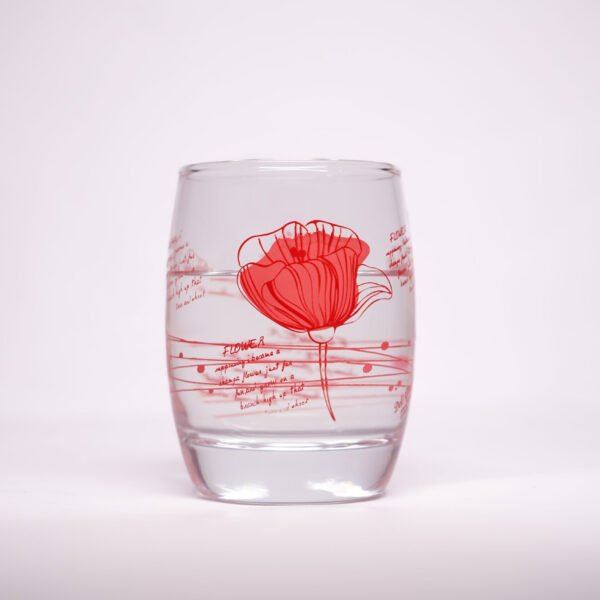
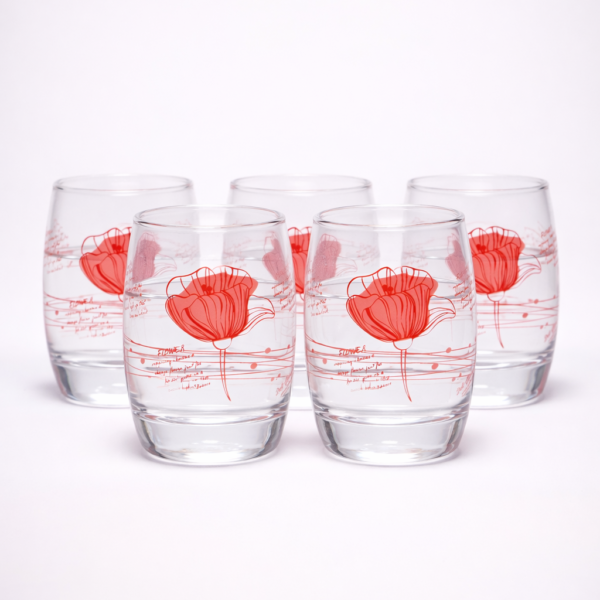
Slimmer and shorter than a water glass, typically 200-230 ml, and suited to fresh juice, lassi, chaas and milkshakes. Clear, undecorated glass is preferred because it lets the colour of the drink show, which is exactly why juice glasses dominate breakfast service and cafe counters. The Italian Juice Glass at 220 ml is the straight-sided version of this shape; the Red Flowers Pattern set at 210 ml is the printed one.
Highball Glasses, and Why Tall Shapes Exist
There is physics behind the height, not just styling. In a narrow glass, ice cubes stack vertically and each cube shields the next, so less ice surface touches the liquid and the melt rate drops. The narrower opening also exposes less liquid to air, which is where carbonation escapes. A soda in a tall highball holds its fizz noticeably longer than the same soda in a wide tumbler – the same reasoning behind serving sparkling wine in a flute.
Highball vs Collins vs Rocks
These three get used interchangeably in Indian retail listings and they are not the same glass. A highball is tall and straight at roughly 240-350 ml, for long drinks over ice. A Collins is slightly taller and narrower again at 300-410 ml, for multi-ingredient cocktails – in practice a 300 ml highball covers both, which is why most homes only need one tall tumbler. A rocks or lowball glass is the outlier: short, wide, thick-based, and built for spirits neat or on the rocks rather than anything long.
What Most Homes Actually Need
You do not need five shapes. A 300 ml tumbler and a 210-220 ml juice glass will cover almost every pour in the house. Add a rocks glass only if someone in the household genuinely drinks spirits neat, and skip the rest until a specific drink demands it.
Buying Guide
How to Choose a Drinking Glass: Seven Checks
Run through these in order. By check four you will usually know what to buy.
1
Start With What It Will Mostly Hold
Not what it could hold – what it will hold four times a day. If the honest answer is water, buy 300 ml and stop overthinking it. If it is juice and lassi at breakfast, 210-220 ml is the better fit. If it is iced coffee and mocktails, go tall.
2
Check the Rim, Not the Base
Everyone checks base thickness. The rim is what actually fails first. Run a finger around the top edge – a properly fire-polished rim feels smooth the whole way round with no seam or rough patch. A rough spot is a chip waiting to happen, usually within the first six months.
3
Judge Weight by Balance, Not Heft
A heavy glass is not automatically a durable one. What you want is a base slightly heavier than the body so the glass stays planted when full. Fill it, lift it, and see whether it wants to tip. A glass that feels unstable full will get knocked over eventually.
4
Match Diameter to the Hands Using It
Roughly 65-75 mm across the body suits most adult hands. Wider than that and a full glass needs a very broad grip, which is exactly why children and older family members drop wide tumblers. For a household with kids, err narrower and shorter.
5
Decide Whether It Has to Stack
Straight-sided glasses nest and save real cabinet space; curved and footed glasses do not. For a cafe or a small kitchen this is not cosmetic – it decides how many glasses fit on a shelf and how often they knock together. Stacked glasses should separate easily; if they wedge, the shape is wrong.
6
Confirm Dishwasher and Refrigerator Behaviour
Plain soda-lime glass is fine in a dishwasher on a standard cycle. Decorated glass depends entirely on how the decoration was applied – a fired-on print survives, a decal or sticker-style transfer peels. Fridge storage is fine; the freezer is not, because water expands as it freezes and will crack the glass.
7
Buying for a Restaurant or Cafe?
Standardise on one capacity and one design per drink type across every table before you order. It keeps pours consistent, makes replacement a single-SKU reorder, and stops the room looking mismatched after the first month of breakage. Request a sample piece before committing to volume.
Quantity
How Many Drinking Glasses Should You Buy?
The rule that works: one glass in use, one in the wash, one on the shelf.
Couple or two-person home – 6 glasses. Four in rotation, two spare. A set of six also survives two breakages before it starts looking depleted.
Family of four – 12 glasses. Six in daily rotation and six kept for guests, so the everyday set never has to be held back.
Households that entertain often – 12 to 18. Enough that a dinner for eight does not need a mid-meal wash.
Cafe, 20 seats – 50 to 60. Roughly three per seat, covering service, the wash cycle and shelf stock.
Restaurant, 40 covers – 120 to 150. Three per cover plus a buffer, and budget 15-20% annually for breakage replacement.
Hotel or banquet – 3 to 4 per cover. Higher turnover and multiple service points mean more glasses in circulation at once.
Buy the Replacements Now, Not Next Year
Shade and pattern placement vary slightly between production batches, and that variation is far more visible on tinted or printed glassware than on clear. A set topped up eighteen months later rarely matches. If you expect breakage – and you should – buy the spares in the same order.
Which Glass Suits Which Setting
Family home: 300 ml plus a 220 ml juice glass. Rim durability and stackability matter most.
Households with young children: 180-220 ml with a narrower body. Grip diameter and a low centre of gravity beat capacity every time.
Office pantry: 250-300 ml, plain and stackable. Easy to replace and able to survive a shared sink.
Cafe: a 300 ml highball plus a 220 ml juice glass. Has to photograph well, stack in tight storage and take a dishwasher cycle every day.
Restaurant table service: 250-300 ml with a thick base, one standard capacity across all tables.
Hotel and banqueting: 300 ml matched across floors, with reorder reliability and transit-proof packaging as the deciding factors.
Gifting: a set of six, tinted or patterned, that presents well out of the box and is still durable enough for daily use afterwards.
Avoid These
Seven Mistakes People Make Buying Drinking Glasses
Buying two at a time. A set assembled piece by piece never matches, and the cost per glass is higher. Buy the full quantity in one order.
Choosing thin rims because they look elegant. They do look better, and they chip within months under daily washing. Save the delicate profile for occasion glassware.
Assuming any glass takes hot liquid. Ordinary soda-lime cracks under thermal shock. If chai has to go in it, you need borosilicate, which is a different product.
Confusing painted glass with tinted glass. Hold it to a light and check the rim and base. Tinted colour runs evenly to the edges; a painted finish leaves a thin clear line where the coating stops.
Freezing drinks in a glass. Liquid expands as it freezes and cracks the vessel from the inside. Chill in the fridge, never the freezer.
Buying one capacity for an entire restaurant. One capacity per drink type is right. One capacity for water, juice and mocktails means overpouring on some and short-serving on others.
Judging quality by weight alone. Heavy glass with a rough rim outlasts nothing. Check the rim finish and the flatness of the base before anything else.
Make It Last
How to Clean, Store and Handle Drinking Glasses
Cleaning
Use a mild detergent and a soft sponge. Abrasive scrubbers and scouring powder leave a network of fine scratches that never come out and slowly turn a clear glass dull. In a dishwasher, load glasses so they cannot touch each other – glass-on-glass contact during the cycle causes far more chipping than the wash itself. Skip the intense sanitising cycle for thin-rimmed glasses; the temperature swing is harder on them than a standard wash.
Fixing Cloudy Glasses
There are two different problems here and only one is fixable. If the cloudiness is a hard-water mineral film, soak the glass in warm water with white vinegar for 15-20 minutes, wash normally and dry with a lint-free cloth – the clarity comes straight back. If the cloudiness survives that soak, the glass is etched, which is permanent corrosion of the glass surface usually caused by too much detergent in soft water. Etching cannot be reversed by any home remedy, and anything claiming otherwise is a polish that wears off.
Storage
Store rim-up on a dry shelf. Rim-down traps moisture and puts the full weight of the glass onto its most fragile edge. Leave a finger’s gap between glasses so they cannot rattle together when a cabinet door shuts, and stack only glasses designed to stack – forcing a non-stacking shape together is how glasses break during separation.
Safety and Heat
Treat a drinking glass as a cold-drink vessel. The failure mode is thermal shock: pouring boiling water into a chilled glass, or moving a glass straight from the fridge into hot water. Both create uneven expansion across the wall thickness and crack it. Plain, undecorated soda-lime glass can be microwaved briefly to warm a liquid, but glasses with metallic rims or printed decoration should never go in a microwave. And a glass with any visible chip on the rim should be retired immediately, not kept for guests.
Why SILICOX
Buying Your Drinking Glasses From SILICOX
We supply single sets to homes and pallet quantities to hospitality buyers, and the quality control is the same either way.
Described Accurately, Not Aspirationally
If a listing says soda-lime, it is soda-lime. If it says fired-on print, it is fired on. We would rather lose a sale to a better-sounding description than have a customer discover the difference after two months of washing.
Packing Built Around Breakage
Every glass ships individually cushioned and partitioned rather than loose in a carton with bubble wrap thrown over the top. Glassware that arrives broken helps nobody, so the packing is designed for transit rather than for the shelf.
Sample Before You Commit to Volume
For cafe, restaurant and hotel buyers, we recommend ordering a sample piece first to confirm weight, rim finish and batch consistency before a full order. It is a small step that prevents an expensive mismatch.
Retail and Wholesale, One Supplier
Sets of 2, 6 and 12 for households, and bulk quantities with GST invoicing and private-label options for hospitality buyers, distributors and online sellers.
Questions & Answers
Frequently Asked Questions
Direct answers to what buyers usually search before purchasing drinking glasses.
What is a drinking glass called?
A drinking glass is called a tumbler – a stemless, handle-free glass for cold beverages. The broader category names are drinkware and glassware. Sub-types are named by capacity and shape: water glass, juice glass, highball, Collins and rocks glass.
What is a synonym for drinking glass?
Tumbler is the closest single-word synonym. Glass, beaker, water glass, drinking vessel and highball are also used depending on context. Stemware and mugs are related terms but not synonyms, since a drinking glass has neither a stem nor a handle.
Which glass is good for drinking?
Soda-lime glass for everyday cold drinks – clear, food-safe, light and inexpensive to replace. Tempered soda-lime if breakage is your main concern. Borosilicate if the same glass must take hot tea or coffee. Lead crystal is the weakest choice for daily use and is not suitable for storing acidic drinks.
What are the 4 types of glass?
In drinkware: soda-lime, borosilicate, tempered (toughened) and lead crystal. In construction the four are usually listed as annealed, tempered, laminated and coated glass. For buying tumblers, the drinkware classification is the relevant one.
What is the standard size of a drinking glass in India?
Between 250 ml and 350 ml, with 300 ml the most common for water at home and in restaurants. Juice glasses sit lower, typically 200-230 ml.
How many ml should I buy for daily water use?
300 ml. It holds a full serving without a refill, takes ice and a mixer comfortably, and is still easy to hold and wash. If you are buying only one capacity, buy this one.
What’s the difference between a drinking glass and a tumbler?
None in practice. Tumbler is the technical term for a flat-bottomed glass with no stem and no handle; drinking glass is the everyday phrase for the same object.
What is soda lime glass?
Glass made from silica, soda ash and lime. It accounts for roughly nine out of ten glass products made worldwide, including most drinking glasses, jars and bottles. It is clear, food-safe and fully recyclable, but it does not tolerate sudden heat.
Are drinking glasses dishwasher safe?
Plain soda-lime glasses are, on a standard cycle. Load them so they do not touch each other and use a mild detergent rather than abrasive powder. Decal or sticker-style decoration should be hand-washed; a fired-on print handles a dishwasher without peeling.
Can hot water or tea be poured into a drinking glass?
Not into ordinary soda-lime glass. It tolerates a sudden temperature swing of only about 30-40 °C before it risks cracking. For hot beverages use borosilicate glass, which handles a swing well over 100 °C.
Which drinking glass breaks the least?
Tempered soda-lime glass. The tempering process puts the surface under compression, making it markedly more impact-resistant, and when it does fail it breaks into blunt granules rather than sharp shards. Within untempered glass, a thicker rim and base will always outlast a thin decorative profile.
Why do my glasses chip so quickly?
Almost always the rim. Thin rims chip under stacking, sink contact and dishwasher rattle. Store glasses with a gap between them, load a dishwasher so they cannot touch, and choose a slightly thicker rim for any set in daily use.
How do I clean cloudy drinking glasses?
Soak in warm water with white vinegar for 15-20 minutes, then wash and dry with a lint-free cloth. If the cloudiness remains, the glass is etched rather than filmed – permanent surface corrosion from detergent, which cannot be reversed.
Is glass safer than plastic for drinking water?
Glass is non-porous, so it does not absorb odours, stain over time or transfer flavours the way some plastics can. It is also inert against acidic drinks and fully recyclable without loss of quality.
Can I keep drinking glasses in the freezer?
Not with liquid in them. Water expands as it freezes and will crack the glass from the inside. An empty glass can be briefly frosted, but chilling in the refrigerator is the safer habit.
How long should a set of drinking glasses last?
Glass does not wear out chemically, so lifespan is entirely a function of handling. A well-finished soda-lime set in a household typically lasts years – the set shrinks through breakage and chipping rather than degrading. Commercial kitchens should plan on replacing roughly 15-20% of glassware annually.
How many glasses does a family need?
A family of four is comfortable with 12 – six in daily rotation and six kept for guests. A two-person household is fine with 6. Buy the full quantity in one order, since batch-to-batch shade variation makes a later top-up visibly mismatched.
Can I use the same glass for water and juice?
Yes. A 300 ml tumbler handles both comfortably. Many homes still keep a slimmer 210-220 ml glass for juice, simply because a smaller glass suits a shorter pour and shows the drink’s colour better.
Are stackable drinking glasses better than regular ones?
For daily use and storage, yes. Straight-sided stackable glasses save shelf space and are less likely to knock against each other and chip. Check that they separate easily when stacked – a shape that wedges causes more breakage than it prevents.
What size glass should I buy for a restaurant?
250-300 ml, thick-based and stackable, is the standard for restaurant water and juice service. Standardise on one capacity across every table so pours stay consistent and replacement is a single-SKU reorder.
Do you supply drinking glasses in bulk for restaurants, cafes and hotels?
Yes. SILICOX supplies bulk quantities to restaurants, cafes, hotels, caterers, distributors and online sellers across India, with GST invoicing and private-label options on eligible orders. Request a sample piece before committing to volume.
Do you deliver drinking glasses across India?
Yes, both individual sets and bulk commercial orders, packed with each glass individually cushioned and partitioned rather than loose in a carton.
The Short Version
Expert Summary
If you take one thing from this page: buy 300 ml soda-lime glasses with a well-finished rim, in a straight-sided shape that stacks, and buy the whole quantity in a single order. That covers water, juice, soft drinks and mixed drinks for a household or a restaurant table without a second thought.
Add a 210-220 ml juice glass if breakfast service matters to you. Add borosilicate only if the same vessel has to take hot tea. Skip lead crystal for anything you use daily. And whichever set you choose, store it rim-up with a gap between glasses – that one habit extends the life of a set more than any material upgrade will.
Tell us how many people you are serving and what they mostly drink, and we will tell you which glass and what quantity actually fits – whether that is one set of six or a hotel-scale order.